Introducing Koda Compass: the AI-native infrastructure for value-based care
September 21, 2026
Introducing Koda Compass: the AI‑native infrastructure for value‑based care
For several weeks, Koda Compass has been running quietly behind every advance care planning and goals‑of‑care conversation our platform facilitates. We’re not launching it today so much as revealing what we’ve built, why we built it, and where we believe it can go.
Compass is the AI‑native infrastructure that now orchestrates the advance care planning and palliative navigation process end to end. Across an entire patient population, it helps determine who needs a conversation, when they need it, what kind of support is right for them, and what should happen next.
That might sound like an ACP problem. We think it’s much bigger than that.
Health systems and health plans already have EHRs, claims data, quality dashboards, outreach tools, and care management infrastructure. The gap wasn’t another tool. It was the intelligence connecting them: a system that could understand where a patient is in a complex care journey, coordinate what happens next, and adapt as that patient’s needs change.
That’s the system we built. It’s Compass, and it’s running today.
The stakes are high: the last year of life accounts for roughly a quarter of Medicare spend, the greatest concentration of utilization in a person’s life, and high‑quality ACP has been shown to reduce it by about 20%. Multiple people are involved, and a plan can unfold over months or years.
THE LAST YEAR OF LIFE
HIGH‑QUALITY ACP
But the infrastructure underneath Compass was designed for something broader: interventions that need to reach the right person, at the right time, with the right level of support, and continue adapting as circumstances change.
In that sense, ACP is the first use case. Compass is the chassis we’re building for what comes next.
The problem was never a lack of tools
At Koda, we know that completing an advance directive isn’t the same as being prepared to act on it.
A patient may need advance care planning but never be offered it at the right time. Another may have a signed directive in the chart, but a family that doesn’t understand their wishes. A designated decision‑maker may not know they’ve been chosen or may no longer be the right person for the role. And a plan that reflected someone’s priorities two years ago may no longer reflect who they are today.
Those aren’t documentation failures. They’re failures of timing, understanding, alignment, and continuity. That’s how a directive can be sitting exactly where it belongs in the chart the day a family gets blindsided anyway.
Long before Compass, Koda had already built a way to address much of that complexity. Patients could learn about their care options from home, talk them through with the people they trust, and arrive at a plan that’s genuinely theirs. Proprietary algorithms continuously risk stratified populations to identify those with the highest need. And for patients who need more support, KodaCares, our team of Patient Advocates with backgrounds in social work and nursing, goes deeper into values, quality of life, family alignment, and who should speak for the patient if they no longer can.
We’ve built our reputation on that combination of guided digital engagement and skilled human support. But as our deployments grew, a different problem became impossible to ignore.
Advance care planning isn’t one workflow. It’s a series of conversations, decisions, and people that can unfold over months or years.
As we scaled, the infrastructure supporting that journey was spread across different systems and vendors. Signals lived in one place. Scoring lived in another. Outreach, education, family engagement, clinical conversations, and EHR write‑back each had their own infrastructure.
Our clinical operations team felt the consequences first. As the number of patients grew, it became harder to answer what should have been a simple question:
Where does this patient stand right now, and what needs to happen next?
That became the problem we needed to solve.
At scale, the hardest part of ACP isn’t capturing another signature or simply surfacing a document. It’s delivering the right intervention at the right time. That means knowing who needs a conversation, who needs deeper human support, what context should inform that conversation, and when a change in a patient’s condition or circumstances means it’s time to come back.
We needed infrastructure that could see across that entire journey and continuously turn what it knew about a patient into the right next action. We had built and assembled real capability. What we hadn’t built was the intelligence connecting it all. Advancements in AI models now gave us the ability to do just that.
So we took a hard look at our own clinical infrastructure, kept what was working, consolidated what wasn’t, and rebuilt an AI‑native system around Compass.
What we realized we needed
Rebuilding gave us the opportunity to start with the way we believe care should actually work, rather than the constraints of the tools we already had. A few principles shaped nearly every decision we made.
Every conversation needed to compound into a clearer picture over time, instead of resetting to zero at the next scheduled encounter. These principles became the architecture for Compass.
What we actually built

Compass runs continuously in our HIPAA‑compliant environment, connected to the data a partner already has: referral channels, claims where they’re shared, admission, discharge, and transfer feeds that can tell us when a patient’s situation has changed. There’s nothing for a partner to install, host, or staff.
From there, Compass orchestrates the process from signal to intervention to verified answer.
The easiest way to understand what Compass does is to follow a patient through it.
It starts by turning fragmented inputs into a patient we can act on. A referral might arrive on a Monday afternoon as a faxed PDF from a nephrology practice. Within minutes, Compass can turn it into a structured intake record, extracting demographics, checking for an existing patient, and attributing the referral to the right provider organization without anyone retyping it. The same process can begin with an email or EHR referral, and where claims are available, clinical risk can help prioritize the population before anyone makes a call.
Then Compass decides what should happen next. Every patient in outreach carries two signals: how much they need a conversation now and how likely they are to engage. The first helps determine the level of support. Together, they help prioritize the work. The goal isn’t to send the most outreach. It’s to figure out who needs attention, what kind, and when.
That logic also determines where we use the scarcest resource in the system: a human conversation. When human follow‑up is needed, the Compass task queue gives KodaCares advocates a prioritized view of who needs attention, why they’re there, what’s already happened, and what should happen next.
For many patients, the right path is digital. For others, it’s a person. A patient might ignore a text on Wednesday, open an email Friday night, and work through the guided conversation over the weekend, in Spanish, at her own pace and in the comfort of her own home. She pauses on the question about who should make decisions for her and comes back the next night. She may never need to speak with anyone at Koda, and that’s not a fallback. It’s the path that worked for her.
Another patient might stall at the same question and never return. Compass carries that context forward. If digital re‑engagement doesn’t work and the partner has KodaCares, the patient can appear in an advocate’s queue with the prior attempts, the reason for escalation, and where the conversation stopped already on the screen. The advocate can start with the question the patient couldn’t answer alone. Nobody starts over.
What comes back is verified, not simply completed. When a plan is signed, a person checks it against that jurisdiction’s signing requirements before anything reaches the chart. An AI reviewer helps flag what needs attention and cite the source material behind its reasoning, but it advises rather than decides. What reaches the record is human‑verified. Once cleared, the patient’s preferences and medical decision‑maker selections flow back as structured, chart‑ready data, and the prior version is revoked so an outdated plan isn’t mistaken for the current one.
And the process doesn’t end when the document is signed. Months later, that same patient’s condition or circumstances may change. A new admission, clinical event, or other signal can bring the patient back into view. Compass already knows the plan on file, the decision‑maker they named, what happened in the last conversation, and the context accumulated along the way.
The question isn’t to start ACP over again. It’s simpler: does this plan still reflect what you want? But that’s not the only question worth asking. A signed plan can still fail the patient if nobody is positioned to carry it out. If Compass shows an unaligned decision‑maker, or a patient without enough support at home to act on their wishes when it matters, that’s a second question: are they actually likely to get the care they asked for?
Surfacing that gap early means it can be addressed while there’s still time: helping align a decision‑maker on what the patient actually wants, or flagging to the care team that a patient needs more support in the home before a crisis forces the issue. If the plan still reflects what the patient wants and they’re positioned to get that care, that understanding can be confirmed. If either isn’t true, the conversation, the plan, or the support around the patient can adapt to what the patient needs.
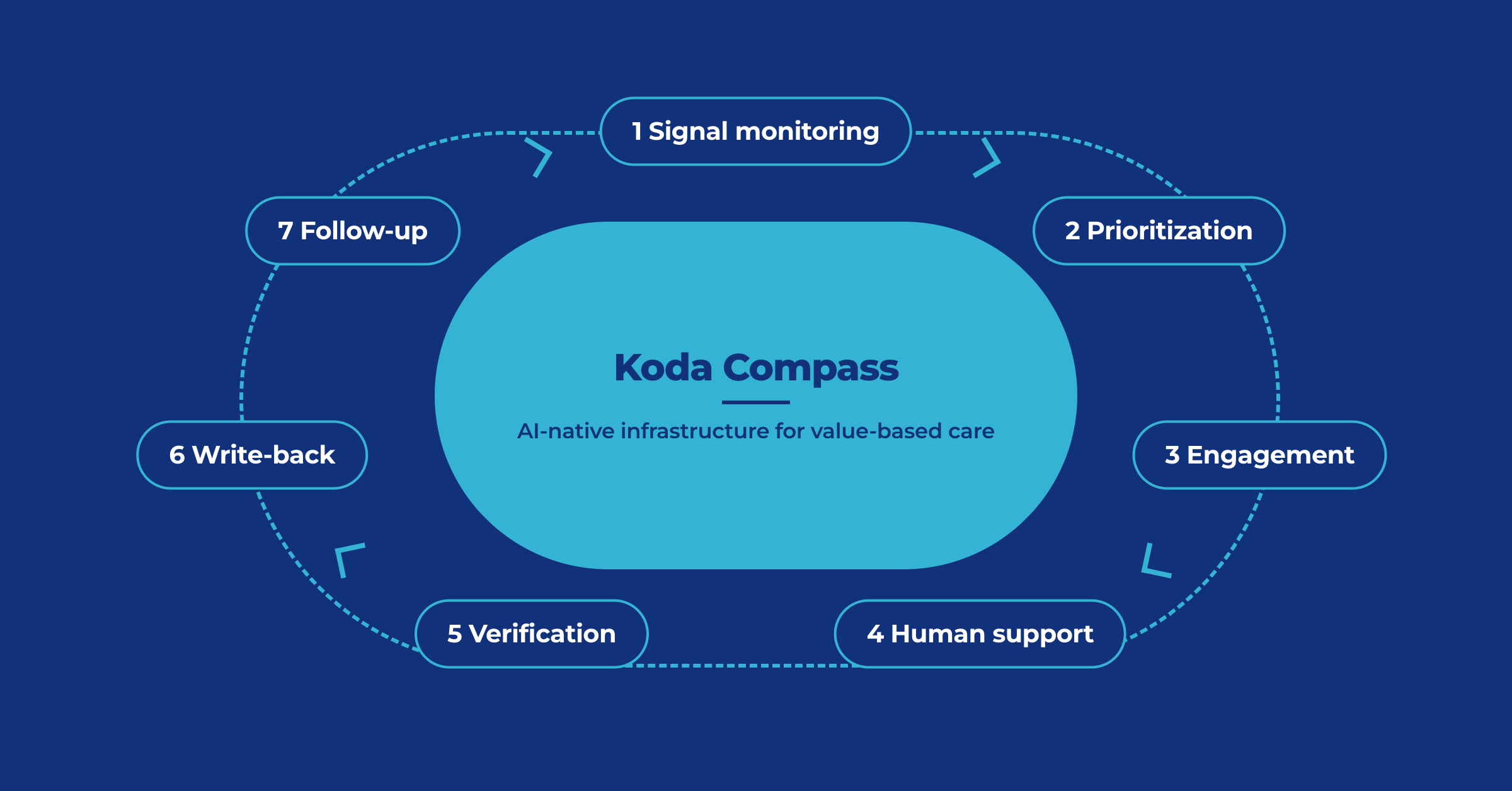
That’s what we mean when we say Compass orchestrates ACP end to end. Intake, prioritization, engagement, human support, verification, write‑back, and follow‑up aren’t separate workflows anymore. Each step adds to the same picture of the patient and helps determine what should happen next.
One patient, eleven panels, seven steps that feed each other
Confirming understanding, not just completion
The Goal‑Concordant Care Score with Compass gives care teams a live view of whether documentation reflects current wishes, a medical decision‑maker is identified and aligned, the patient’s values are understood, and the plan has been updated when goals shift.
Teach Back goes further. After KodaCares conversations, advocates assess whether patients and surrogate decision‑makers actually understand what was discussed, across areas like diagnosis, prognosis, treatment plans, and interventions.
Documentation tells us an activity happened. Comprehension and alignment tell us whether it’s likely to hold up when a real care decision has to be made.
This is how the gap surfaces before it becomes a crisis. An unaligned decision‑maker or a patient without enough support at home doesn’t wait to show up as a bad outcome. It shows up as a lower Goal‑Concordant Care Score, and the care team can act on it while there’s still time.
A plan doesn’t exist in isolation. Compass also builds a longitudinal picture of everything around it: who was in the room for each conversation, whether that’s the patient, family, a caregiver, or a legal guardian, and the social context that shapes whether a plan actually holds. Living situation, caregiver support, family dynamics, and health literacy aren’t background details. They’re often the difference between a plan that works and one that looks fine on paper.
What this means beyond ACP
We built Compass for advance care planning first because it’s one of the hardest versions of this problem: multiple parties, shifting circumstances, high stakes, and a plan that has to stay true over months or years. But the infrastructure underneath it isn’t specific to ACP.
Those are value‑based care problems. They show up anywhere an organization is accountable for an outcome that unfolds across multiple encounters, from chronic disease management and care transitions to complex case coordination.
That’s why we think about Compass less as an ACP product and more as AI‑native infrastructure for patient‑centered care: a system that can understand where a patient is, determine what should happen next, and orchestrate the right intervention as circumstances change.
We built it to solve our own hardest problem first. We believe the same infrastructure can carry much more from here.
Compass is live today across Koda’s health system and health plan partners, running behind every ACP and goals‑of‑care conversation we facilitate. Over the next few months, we’ll be sharing what we’re learning from those deployments and where we’re taking Compass next.