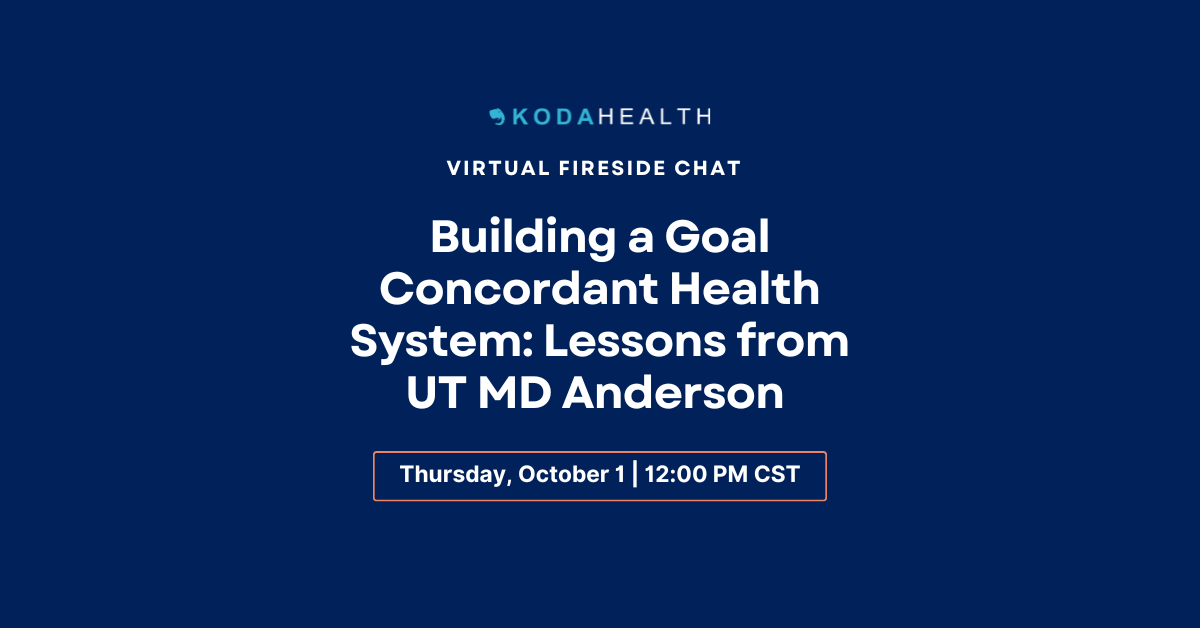
Virtual Fireside Chat | Building a Goal Concordant Health System: Lessons from UT MD Anderson
August 21, 2026
Documenting a patient’s wishes and honoring them are not the same thing. That gap sits at the center of a recent webinar hosted by Koda Health and the Coalition to Transform Advanced Care (C-TAC), where leaders from UT MD Anderson Cancer Center walked through six years of work building the infrastructure to close it.
The conversation arrived at a pointed moment. CMS recently finalized the 2027 inpatient rule, the first federal hospital quality measure for advance care planning. Hospitals start reporting it in 2028, with scores published publicly on Care Compare. For a field that has spent a decade arguing that documentation drives behavior, that is the moment measurement becomes mandatory.
Three voices led the discussion. Dr. Ravi Parikh, a medical oncologist at Winship Cancer Institute at Emory and a C-TAC board member, opened with the national picture. Dr. Nico Nortjé, Associate Vice President for Clinical Ethics and Goal Concordant Care at MD Anderson, walked through how the cancer center built its program from the ICU outward. Dr. Desh Mohan, Chief Medical Officer at Koda Health and a practicing hospitalist in Houston, moderated.
|
<5%
of patients had a documented goals-of-care conversation, in research settings cited by Dr. Parikh
|
80%+
of patients say these conversations matter to them, per the survey data Dr. Parikh referenced
|
6 yrs
MD Anderson’s build, from ICU pilot to a 200,000-patient enterprise program
|
A field that knows what good looks like, but rarely delivers it
Parikh framed the problem as a systems failure rather than a patient one. In research settings, fewer than 5% of patients walking into a cancer center had a documented goals-of-care conversation, even though more than 80% of patients say these conversations matter to them. The two numbers don’t square unless the breakdown is structural: conversations that should happen are getting lost between departments, competing with a packed clinic schedule, or stuck in a scanned PDF at another hospital where the next care team never sees them.
“Documenting a patient’s wishes is necessary, but it isn’t necessarily the same thing as delivering care that honors them.”
— Dr. Ravi Parikh, Emory/C-TAC
Nortjé added a financial and ethical dimension. A quarter of cancer patients experience bankruptcy, and CMS data shows roughly 40% of healthcare spending lands in the last 30 days of life, often on care patients didn’t want.
How MD Anderson built the infrastructure, piece by piece
Nortjé was careful to frame MD Anderson’s six-year effort as a philosophy rather than a single product rollout:
Leadership first. Before any tool or training rolled out, Nortjé’s team secured buy-in from the president, COO, and CFO, so the work was treated as a system-wide obligation rather than one department’s side project.
Training on both sides of the conversation. Physicians trained in the Serious Illness Conversation Guide from Ariadne Labs, reaching close to 80% of MD Anderson’s roughly 3,000 physicians. Bedside nurses, social workers, and chaplains trained on the COMFORT model, developed at the University of Tennessee, to prepare patients before a physician conversation and reinforce it afterward, since patients retain only a fraction of what they hear from a physician under stress. For patients arriving for second opinions late in their disease course, teams adopted the READI program from Cleveland Clinic to build trust quickly.
A partner for the patient-facing piece. Rather than build a digital tool internally, MD Anderson partnered with Koda Health for a platform patients complete at their own pace, at home, working through questions, scenarios, and videos instead of a rushed conversation in a waiting room.
Real-time integration into Epic. Once a patient completes the digital questions, their values appear on the patient storyboard in Epic, visible to any physician, nurse, respiratory therapist, or social worker on the care team, at any hour.
The result today: roughly 200,000 patients a year, more than 3,000 clinicians, and every patient with MyChart access to the digital advance care planning tool.
Why this is a quality and safety issue, not just a patient-experience one
The pitch that got MD Anderson’s leadership to prioritize this work wasn’t framed around patient experience alone. Nortjé positioned it as quality: reducing variation, improving decision-making, and keeping care delivery consistent for patients with similar clinical pictures but different values. He also connected it to clinician wellbeing, pointing to high rates of burnout among clinicians forced to make high-stakes ICU decisions without knowing what the patient would have wanted, and to nursing turnover, which he called a crisis in its own right.
Where the field goes next
Both Parikh and Nortjé expect the next two to three years to shift the conversation from whether a conversation happened to whether it shaped care. CMS’s new measure asks whether hospitalized patients’ preferences are identified, communicated, and incorporated into clinical decisions reliably and at scale, not just documented once.
Parikh grouped health systems into three categories: those treating this as a documentation exercise through new EHR templates, those scaling existing palliative and chaplaincy programs with digital tools because staffing alone can’t cover every discharge, and a smaller group, MD Anderson among them, building durable infrastructure for identification, conversation, documentation, and measurement together.
His advice to health system leaders: find your baseline discharge rate for advance-care-planning conversations first, since most systems are surprised by how low it is. Then pick one high-risk population and one clinical champion rather than trying to change the system all at once.
“Goal-concordant care does not happen by accident. It requires the same level of intentionality, infrastructure, and accountability that we bring to quality, safety, and operational excellence.”
— Dr. Nico Nortjé, MD Anderson
|
Watch the full conversation on demand
This recap covers the highlights. The full recording includes the panel’s complete answers on staff training models, the build-versus-partner decision, and live audience Q&A.
|