The New CMS Advance Care Planning eCQM, Explained: What Hospitals Report, When, and How
August 3, 2026

For the first time, CMS has made Advance Care Planning a finalized federal hospital quality measure. The FY2027 IPPS final rule (CMS-1849-F) adopts the ACP eCQM (CMS1317) into Hospital IQR, Promoting Interoperability, and the PPS-Exempt Cancer Hospital Quality Reporting Program (PCHQR). Reporting starts CY2028.
This guide covers what is actually being measured, why most hospitals are not set up to score well on it, and how Koda’s platform is built to close that gap.
What is being measured
The programs and the stakes
| Program | Status | What it means operationally |
|---|---|---|
| Hospital IQR | Finalized as proposed | ACP joins the self-select eCQM pool for CY2028 reporting and FY2030 payment. Public reporting on Care Compare after a 30 day preview. |
| Promoting Interoperability | Finalized as proposed | Same measure, same timeline. PI failure carries its own payment penalty. |
| PCHQR (cancer hospitals) | Finalized with modification | Voluntary and confidential in CY2028, mandatory CY2029 and FY2031. Only 11 PPS-exempt cancer hospitals nationally face this. |
CMS rejected every request to delay adoption. Commenters asked for more lead time to build EHR templates and workflows. CMS answered that self-selection already provides flexibility. In practice: CMS knows most hospitals are not ready, and treats that as the hospital’s problem to solve.
The self-selection math
For CY2028, hospitals report 14 eCQMs: 11 CMS-selected, plus 3 chosen from a pool of 5 (two anticoagulation measures, CT radiation dose, postoperative VTE, and ACP). In FY2032 that pool shrinks to 4 pick 3, with VTE going mandatory, so the odds of ACP being selected only go up over time.
A hospital that expects to score poorly might avoid selecting ACP entirely, at least for now. But ACP is arguably the most improvable measure in the pool. The anticoagulation and imaging measures are mature clinical-protocol problems with limited headroom. ACP is a workflow and documentation problem, exactly the kind of gap a purpose-built platform can close by 20 or more points in a measurement cycle. As the pool shrinks, hiding from it gets harder.
What actually counts
Denominator: every inpatient discharge, age 18 and over, with no exclusions by age, acuity, or length of stay. This is the broadest denominator CMS has ever attached to ACP.
The benchmark hospitals will be judged against
CMS published performance data from 43 test hospitals. This is the number that will sit next to a hospital’s name on Care Compare.
Top decile sits below 61%. The ceiling is wide open.
100%
Hospitals that start building in 2027 have a realistic shot at posting top-decile numbers. Hospitals that wait until 2028 can only manage the fallout after their score is already public.
Why most hospitals aren’t ready
Put the requirements together and a pattern emerges. To score well, a hospital has to do five things at once.
How Koda maps to every requirement
This is a documentation and workflow problem at population scale, and it is the problem Koda was built to solve. The platform is patient-led, so the education and decision-making happen outside the clinical encounter, then land in the record as structured data your quality team can report on.
| What the measure requires | The gap most hospitals have | How Koda closes it |
|---|---|---|
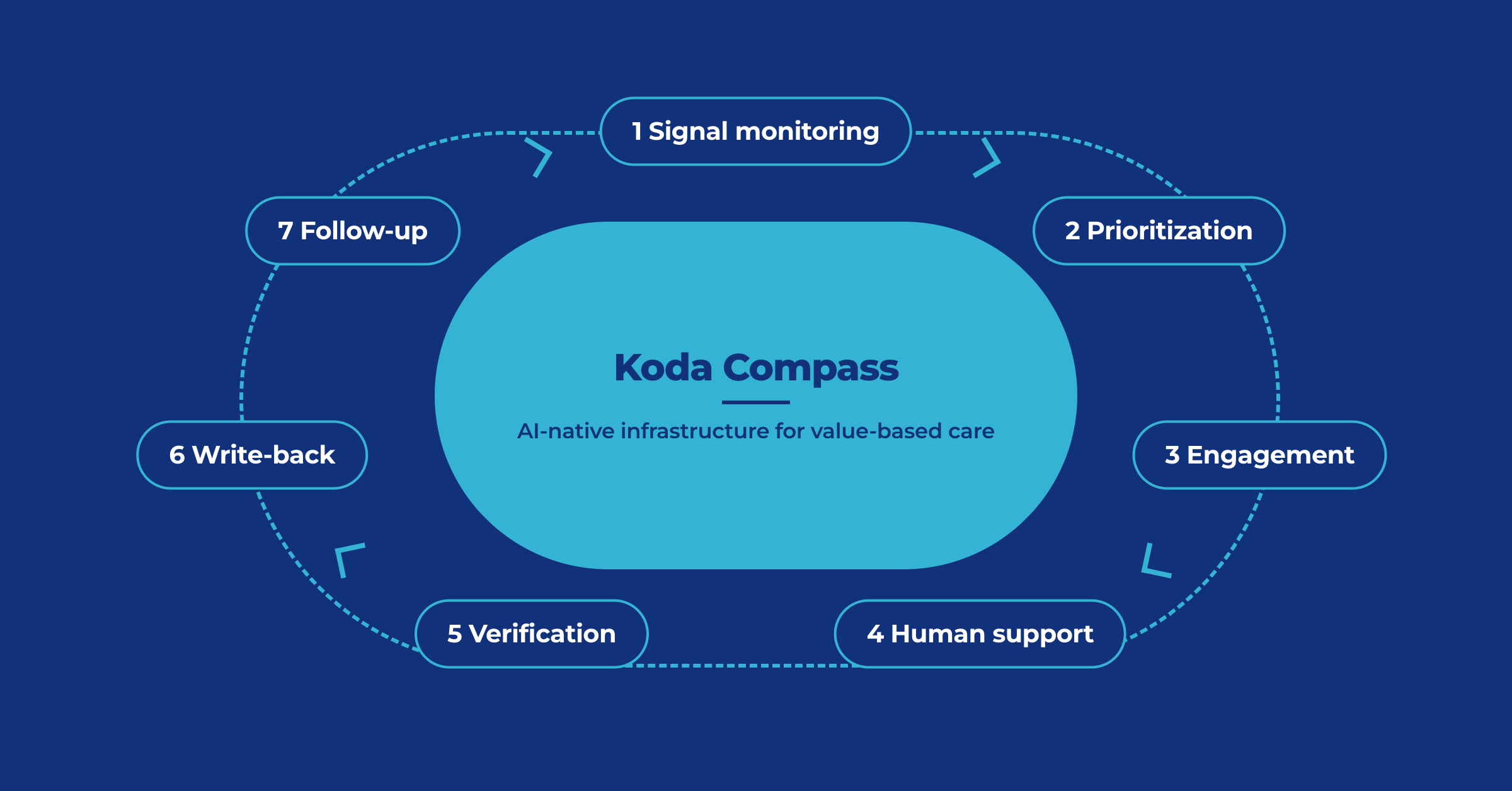
| ACP across every inpatient discharge, 18 and over, no exclusions | Manual palliative or chaplaincy-led conversations cannot scale to a full inpatient census | Koda Compass identifies and routes patients for ACP conversations at scale, using predictive intelligence to flag who needs a conversation and when, so coverage is not limited by staff bandwidth |
| Pre-existing documents must be findable in the EHR at discharge | Directives completed outside the hospital, through a health plan, a PCP, or a prior admission, often sit outside the inpatient EHR entirely | Koda’s Epic write-back pushes every plan completed through Koda, wherever it originated, directly into the patient’s record, so it is discoverable at the moment that matters |
| A documented discussion needs a documented decision, not just a billed encounter | Conversations happen, get billed under 99497 and 99498, and the outcome never makes it into structured fields | Koda captures the discussion and the resulting decision in structured, discrete EHR fields built to satisfy the numerator, not just the billing code |
| Surrogate designation and capacity-based documentation, including refusals | Surrogate conversations and refusal-to-designate scenarios are often handled inconsistently or not documented at all | KodaCares provides the longitudinal, human-escalation layer that manages surrogate-involved conversations and ensures the outcome, including a refusal, gets documented correctly |
| Consistent, reliable data across a large population | One-off documentation efforts produce spotty records that do not hold up against CMS’s reliability testing standard (0.9987 in CMS testing) | Koda’s structured workflow produces consistent, EHR-native documentation across every patient touched by the platform, not a patchwork of formats and completeness |
| Legally valid documents wherever your patients live | Paper packets and homegrown forms vary by state, and witnessing or notary requirements are handled inconsistently across markets | Koda is compliant in all 50 states, with state-specific advance directive and surrogate forms and the execution requirements built in |
| Health plans and ACOs want to support their network hospitals’ scores | Payers have no mechanism today to influence a partner hospital’s inpatient quality measure | Because pre-existing documents count with no recency requirement, a health plan or ACO sponsoring Koda for its members directly improves the federal quality scores of every hospital in its network |
What your organization should do in the next 90 days
Get ready in 2027, not after the score is public
We will walk your quality and clinical leaders through the measure, benchmark your likely starting point, and show what a patient-led ACP workflow looks like inside your EHR.