What Patients Are Telling Us: Three Data Points That Reframe Serious Illness Care
February 19, 2026

We talk a lot about the importance of advance care planning — the conversations, the documentation, the decisions that need to happen before crisis forces them. But data from Koda’s patient population offers something more powerful than talking points: it shows us what patients actually want when they’re given the space and support to say so.
Here are three findings from our patient population that we think every organization responsible for serious illness care should know.
1. When patients are asked, most choose comfort over intervention.
80% of all members who completed their care guide expressed a preference for hospice care.
This number tends to surprise people. The assumption in many care settings is that patients want aggressive treatment, that they’ll push for every possible intervention. But when patients are guided through a thoughtful, supported planning process, the picture is very different. The overwhelming majority express a preference for comfort-focused care.
This isn’t a reflection of patients giving up. It’s a reflection of patients finally being asked. When serious illness planning is designed to meet people where they are in their own time, in plain language, without the pressure of a clinical encounter, patients engage honestly. And honestly, most people want quality of life over quantity of interventions.
For health plans and accountable care organizations, this has significant implications. Unmet preferences for comfort care don’t just represent a quality gap, they represent a cost gap. When patients who would choose hospice end up in the ICU instead, that’s not a clinical inevitability. It’s a planning failure.
2. Patients lean on the people closest to them — and that person is almost always family.
75% of members who designated a Medical Decision Maker chose either a spouse or child.
This finding reinforces something clinicians already know intuitively: when patients face serious illness, they turn to family. But it also carries an important operational implication: effective advance care planning can’t be designed for patients alone. It has to account for the family members who will ultimately be asked to make decisions, advocate for care, and navigate an unfamiliar system under enormous emotional pressure.
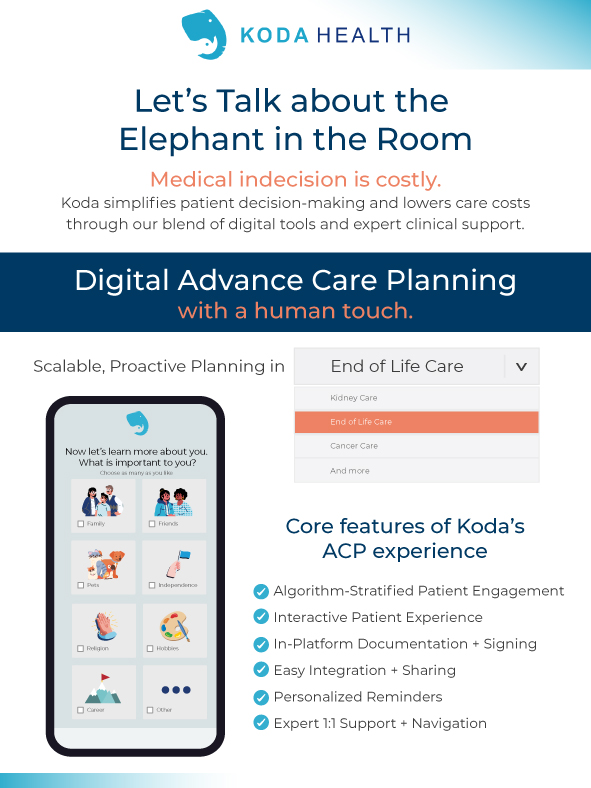
Koda’s platform is built around this reality. Family members can be brought into the planning process from the start, ensuring that the person who will be called upon in a crisis isn’t hearing a patient’s wishes for the first time in a hospital hallway.
3. Serious illness planning isn’t just for the oldest patients — it spans a much wider population than most assume.
The average age of members who complete their care guides is 69 years old, with a standard deviation of 12 years.
The average age matters. But the standard deviation is important to note as well.
A standard deviation of 12 means the majority of planning activity is happening across a wide range — from patients in their late 50s to those in their early 80s. This isn’t a narrow cohort of the very elderly. It’s a broad, diverse population that includes people who are decades from end of life but living with serious, complex illness today.
That has real implications for how organizations think about deploying advance care planning programs. Waiting until patients are in their late 70s or beyond to initiate planning means missing a significant portion of the people who need it most, and missing the window when earlier planning can have the greatest impact on care quality and cost.
What this tells us
Together, these three data points paint a consistent picture: patients want to plan, they want to involve the people they trust, and they want care that aligns with their values, not just their diagnoses. The barrier isn’t patient willingness. It’s access to a planning process that actually works.
Koda Health is an advance care planning platform designed for health plans and accountable care organizations. Our patient population data reflects aggregated, de-identified insights from members who have completed care planning guides through the Koda platform.