How Proactive Care Planning Changes the Cost Curve
January 5, 2026

It’s not the paperwork that saves money, it’s the proactive conversations that drive measurable ROI in value-based care
One question that often surfaces from clinical and population health leaders:
“How does a piece of paper drive down costs?”
The short answer: it doesn’t.
An advance directive sitting in an EMR or buried in a file doesn’t change utilization or outcomes. The 40% reduction in total cost of care our partners see isn’t driven by documentation alone.
It’s driven by proactive care planning: the structured, supported conversations that happen before a crisis, bringing patients, families, and care teams into alignment early.
Proactive Care Planning Is the Real Work of ACP
For organizations managing total cost of care, proactive care planning isn’t a compliance exercise. It’s a clinical and operational strategy.
When patients and families talk about what matters early, they make better-informed choices. That alignment is what prevents:
- The $50,000 ICU admission no one wanted
- The last-minute transfer that adds suffering but no value
- The missed hospice opportunity that leaves families asking, “Is this what they would have wanted?”
Effective proactive care planning changes both the care experience and the cost trajectory.
Advance care planning isn’t about checking a box. It’s about creating clarity—between patients, their loved ones, and their care teams—so decisions reflect values, not panic.
Koda’s Approach: From Paperwork to Proactive Care Planning
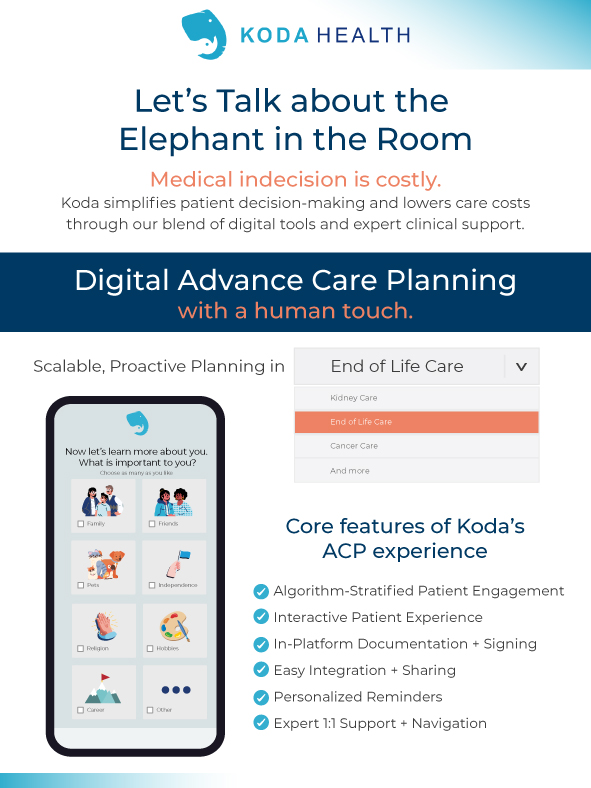
At Koda Health, we built our platform around one principle: proactive care planning works when it’s accessible, guided, and integrated into care delivery.
We’ve learned that impact depends on four things:
- Accessible education that helps patients understand their choices in plain language
- Guided digital tools that make planning easier, not overwhelming
- Workflow integration so clinicians can see, trust, and act on plans in real time
- Human support when needed for complex or emotional situations
When proactive care planning becomes part of the care journey—not a one-time task—it changes outcomes.
The Results of Proactive Care Planning
Here’s what our partners see when proactive care planning is done well:
- 79% reduction in terminal hospitalizations
- 38% fewer ICU admissions
- ~$8,500 average savings per patient
- 40% lower total cost of care in the last year of life
These results are the downstream effect of early, informed, supported conversations about what matters most, achieved without adding clinician burden or diverting care management resources.
Clarity From Proactive Care Planning Saves More Than Costs
When families understand their loved one’s wishes, they don’t default to “do everything.” When care teams can see patient goals, they don’t order interventions that contradict them. And health systems avoid absorbing DRG losses from ICU stays that shouldn’t have happened.
This is the power of proactive care planning: person-centered, aligned, and connected.
It looks like this:
- Proactive engagement: Identifying patients early through risk stratification—not after hospitalization
- Guided digital education: Step-by-step support that helps patients and caregivers articulate values
- Care team visibility: Preferences integrated directly into the EMR and surfaced at the point of care
This isn’t more work for providers. It’s better alignment for patients, clinicians, and organizations operating under value-based contracts.
Proactive Care Planning as Infrastructure
Koda’s digital platform supports the full proactive care planning journey—from identifying high-risk members to educating families, documenting preferences, and updating plans as conditions evolve.
It transforms ACP from a paperwork exercise into a strategic lever for quality, patient experience, and total cost of care.
Proactive care planning creates alignment before a crisis, compassion when it matters most, and savings that follow naturally from better care.
Because the paper isn’t what drives change. The proactive conversation is.